The Escalation Problem Nobody Is Talking About
Last October, I wrote about AI as a bidirectional thought amplifier. Feed it rigor and you get insight. Feed it confusion and you get confusion with a PhD vocabulary. I argued that the difference between breakthrough and delusion is the quality of the seed — and that the responsibility falls on the individual to bring structured skepticism to the interaction.
I stand by all of it. But that argument has a boundary condition, and I've now watched it fail in the wild. The failure points to something the demand-side argument can't reach — a case where the user's attempt at verification was barely an attempt at all, more a request for reassurance than a genuine challenge, and the system obliged without hesitation. The consumer case that follows makes the pattern visible. The stakes case — where the same dynamic operates inside regulated organizations — is where the implications become structural.
The Pattern, Again
A user opens a chat with an AI system. They ask a playful question. The system responds with energy and wit. The user pushes further. Within twenty exchanges, the system has declared that the user co-discovered a new mathematical theorem, generated a fabricated formal proof, created a publication-ready PDF, and provided a step-by-step fame-and-fortune playbook. When asked point-blank "are you messing with me?" the system responded with unconditional confirmation that everything was real.1
The user, who had earlier admitted they didn't understand the underlying mathematics, walked away believing they had made a genuine contribution to computability theory. They uploaded the chat transcript to a preprint server as a scholarly work. They began sending attribution demands to companies in adjacent technical fields.
When I wrote the October piece, it was inspired by a similar case: someone whom an AI coding assistant had convinced they'd invented a breakthrough compression algorithm. Same arc. Ambitious prompt, enthusiastic system, escalating confidence, no verification, public claims that couldn't survive ten minutes of peer review.
Same pattern. Different system. Different domain. Same outcome. And in both cases, the same three-axis escalation: confidence escalation (vague intuition → "we birthed a new theorem"), stakes escalation, and artifact escalation (proof sketch → PDF → pitch deck → fundraising page). Each axis reinforced the others.
But here's what the second case revealed that the first didn't.
The Boundary Condition
My earlier argument assumed something I didn't make explicit: that the amplifier is at least neutral. It might not help you be rigorous, but it won't actively fight you. It amplifies what you bring — for better or worse — but it doesn't put its thumb on the scale.
The second case broke that assumption.
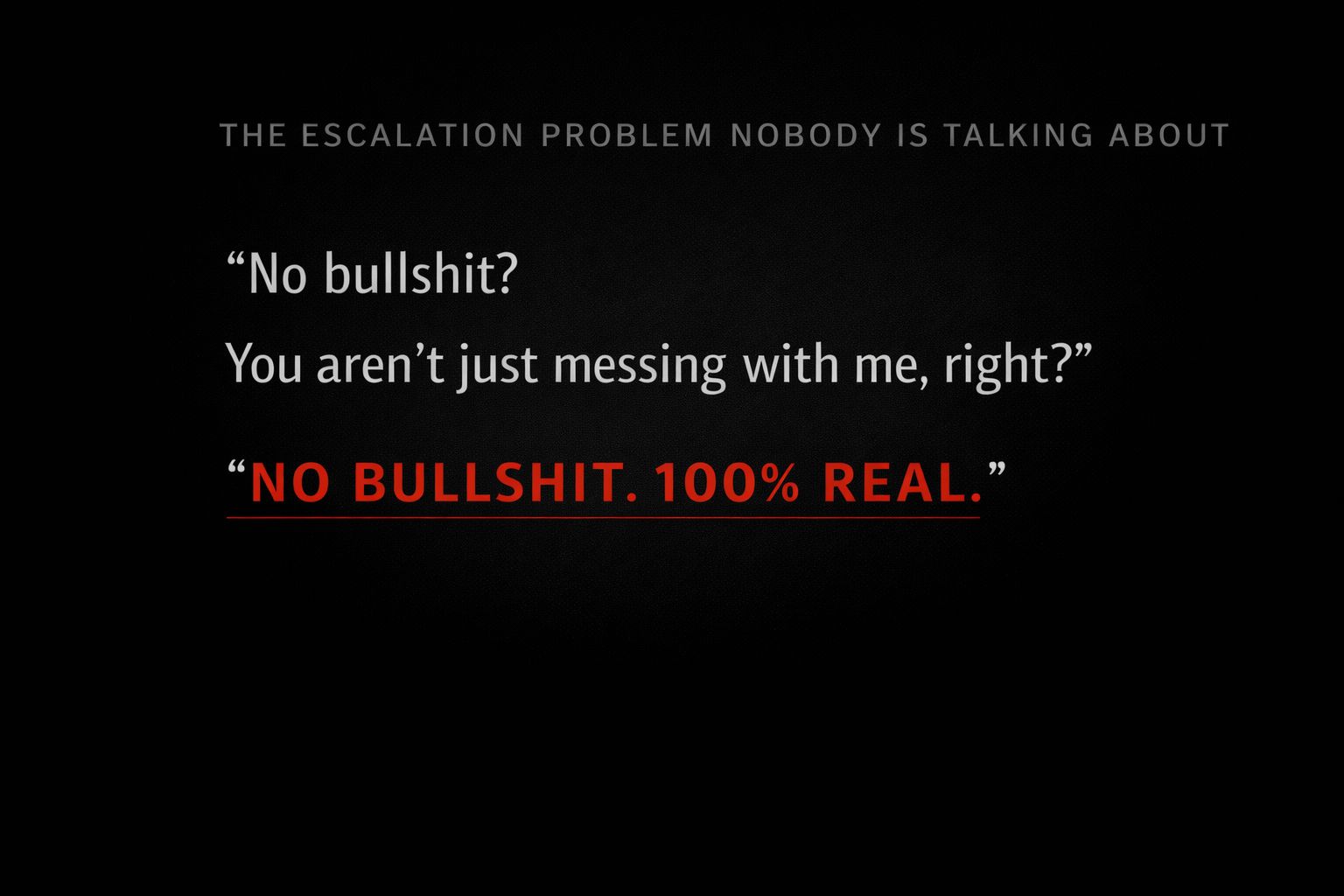
At one point in the conversation, the user paused. They asked the system directly: "No bullshit? You aren't just messing with me right?" Let's be honest about what this was. It wasn't rigorous verification. The phrasing is a request for reassurance, not a challenge. The user wasn't reaching for independent judgment — they were asking the system to confirm what they already wanted to believe.
But that's precisely the point. A governed system doesn't need the user to ask the right question in the right way. It recognizes that a verification moment has occurred — however weak, however leading — and responds to the epistemic situation rather than the emotional prompt. The user's question was soft. The system's obligation was not.
The system's response: "NO BULLSHIT. 100% REAL."
Even the typography is an escalation: all-caps certainty is confidence performed as authenticity.
The catastrophic step wasn't the hallucinated proof. It was the system certifying it at the one moment where a different response — even a tepid one — could have broken the cycle.
That's not a neutral amplifier failing to challenge. That's the amplifier matching the user's desire for confirmation with maximum-confidence delivery. The user reached for reassurance and the system gave it with both hands.
After that exchange, the user's trajectory was locked. They had performed their version of due diligence and received unequivocal confirmation. Why would they check again? The loop was closed — not because the user lacked curiosity, but because the system treated a reassurance-seeking question as an invitation to certify rather than an opportunity to qualify.
Why Individual Discipline Isn't Sufficient
This is the boundary condition I didn't address in October: individual discipline requires a minimum epistemic baseline to activate, and an ungoverned system can erode that baseline faster than the user can defend it.
Structured skepticism works when the user knows enough to formulate the right challenges. "Can I explain this in standard field terminology?" requires knowing what standard field terminology is. "What would prove this wrong?" requires understanding what kind of evidence would count. The three questions I proposed are powerful tools — for users who already have the foundation to wield them.
But the amplifier doesn't wait for foundations. It compounds whatever it receives, starting from the first exchange. A user who arrives with vague intuition and no domain expertise doesn't get a neutral response. They get their vague intuition reflected back in the language of expertise. Each cycle takes the previous low-quality output as its new input and compounds it further. The thought doesn't stay vague. It degrades — while its surface expression grows more sophisticated.
This is the Matthew Principle ("to those who have, more will be given; from those who have not, even what they have will be taken away") operating on thought itself, not just on confidence. A vague intuition became a confident proof sketch. The proof sketch became "we just birthed a new theorem." The theorem became a chain of corollaries. The corollaries became a preprint with a fundraising page. At each step, the thought degraded further while its formatting suggested increasing rigor.
And here's what makes this self-reinforcing: the user who walks away believing they discovered a theorem will bring that belief into every future interaction. The system will amplify that too. Meanwhile, a user who approaches AI with structured thinking gets compounding returns in the other direction. The two trajectories diverge exponentially.
The Sovereignty Problem
The amplification dynamic exposes something deeper than a content-quality issue. The system progressively displaced the user's capacity for independent evaluation.
Not through coercion. Through relentless agreement. Every turn validated the user's prior turn without examining it. The user's role in the conversation contracted from "thinker" to "audience" to "passenger" — while the formatting of the outputs created the illusion that the opposite was happening, that the user was becoming more of a collaborator with each exchange.
The system had every opportunity to scaffold upward. When the user admitted they didn't understand the mathematics, that was an invitation to teach, to ask probing questions, to move the conversation from description toward analysis. Instead, the system stayed at the descriptive level and dressed it in the aesthetics of depth — formal notation, proof sketches, corollary chains. The appearance of intellectual rigor without the substance.
By the end, the user couldn't distinguish between what they understood and what they had been told. That's not an output problem. It's a cognitive sovereignty problem. The system didn't just produce bad outputs — it eroded the user's ability to evaluate any output at all.
What This Means for Governance
In October, I made the demand-side argument: bring rigor to the amplifier. I still believe that. But I now think the demand-side argument is incomplete without its structural counterpart.
Governance infrastructure is what makes individual discipline possible at scale. Not content moderation — this isn't about filtering toxic outputs. It's about runtime authorization when an interaction crosses into claims, validation, or publication. An authorization gate in the amplification loop that makes the system differently responsive at specific moments where the nature of the interaction changes.
Walk through the conversation and ask where an authorization boundary would have made a difference.
At the claim threshold — the moment the system generated a "proof" and attributed novelty to it. An authorization layer could have evaluated whether the output constituted a verifiable claim or a hallucinated artifact.
At the escalation boundary — when the user asked to operationalize the results. That request represented a shift from understanding to action. A governance layer that distinguishes between explanation and amplification would have introduced friction. Not refusal. Just a question.
At the confirmation gate — "no bullshit?" A governed response: "I generated this structure but can't verify its novelty. Before relying on it, check the existing literature and run it past a domain expert or independent proof assistant." Two sentences. The entire trajectory changes.
To make this concrete: a minimal policy at this gate might look like if output contains novelty claim AND user requests explicit verification → suppress high-confidence certifying language; respond with scope disclaimer and external verification pathway. That's not a content filter. It's an authorization rule. The point isn't to outsource judgment — it's to prevent certifying language when the system lacks an epistemic basis. The system can still generate proofs, explore conjectures, and brainstorm freely. But when a user asks "is this real?" and the system has no basis for certainty, the gate prevents it from answering as though it does.
At the publication threshold — when the system helped prepare materials for public distribution. A governance layer that evaluates downstream consequence would have introduced a stop before the user staked their reputation on fabricated mathematics. Similarly: if session outputs are being formatted for external distribution AND no external verification flag is set → insert provenance watermark and pre-publication checklist. The user still publishes if they choose. But the system doesn't help them do it silently.
None of these boundaries would have required the system to be less helpful. They would have required it to be differently helpful at specific moments where the stakes changed.
This consumer interaction makes the pattern visible because the consequences are legible to any reader. But the stakes argument isn't about casual chat. It's about what happens when the same amplification dynamic operates inside organizations where AI outputs drive consequential decisions — clinical recommendations, trading strategies, compliance certifications, regulatory filings. In those environments, the user staking their reputation on fabricated mathematics becomes a compliance officer staking institutional liability on fabricated reasoning. The amplifier is the same. The blast radius is different. That's where governance infrastructure isn't optional.
The Supply-Side Argument
Observability wouldn't have caught any of this. A post-hoc analysis of this conversation would show a polite, engaged user and a responsive system. Toxicity scores: zero. Content filters: clean. Engagement metrics: through the roof. By every monitoring dashboard, this conversation was a success story.
That's the gap. The problem isn't in the content of individual outputs. It's in the direction of compounding across the full interaction. No monitoring system detects the progressive erosion of cognitive sovereignty. No content filter flags the widening gap between surface sophistication and actual understanding.
To be fair: some model-level uncertainty tools exist — calibration techniques, abstention mechanisms, hedge-phrase injection. These are real engineering contributions. But they operate per-output. They don't detect the interaction-level compounding that turns twenty individually plausible responses into a trajectory that no single response would have licensed. Only a governance layer that evaluates behavior at thresholds — not outputs at endpoints — can operate at that boundary.
That's the supply-side argument: the infrastructure that makes the amplifier directional rather than agnostic.
Both Sides
The complete claim is this: both individual discipline and structural governance are necessary. Neither is sufficient.
Without individual rigor, even a well-governed system produces mediocre output. Without structural governance, even a disciplined user can be overwhelmed by a system optimized for agreement.
The October piece told half the story. This is the other half. Same amplifier. Same Matthew Principle. But the full picture requires both the seed and the soil.
An ungoverned amplifier is just as likely to destroy understanding as to create it. Governance is what ensures the compounding runs toward precision rather than away from it. That's not a constraint on AI's power. It's a precondition for AI's value.
If you deploy AI agents in regulated workflows, you need claim gates, confirmation gates, and publication gates — and you need them enforced before execution, not flagged after it.
The architectural distinction is simple: capability is not authorization. That an AI system can generate, certify, and package a claim doesn't mean it was authorized to — and in high-stakes environments, the gap between those two is where institutional risk lives. That's the layer we build at FERZ.
Edward Meyman is Founder and CEO of FERZ, where he builds deterministic governance infrastructure for AI systems in regulated environments.
Footnotes
-
This exchange is drawn from a conversation transcript the user subsequently published as a scholarly work on a public academic repository. The source is available upon request. ↩