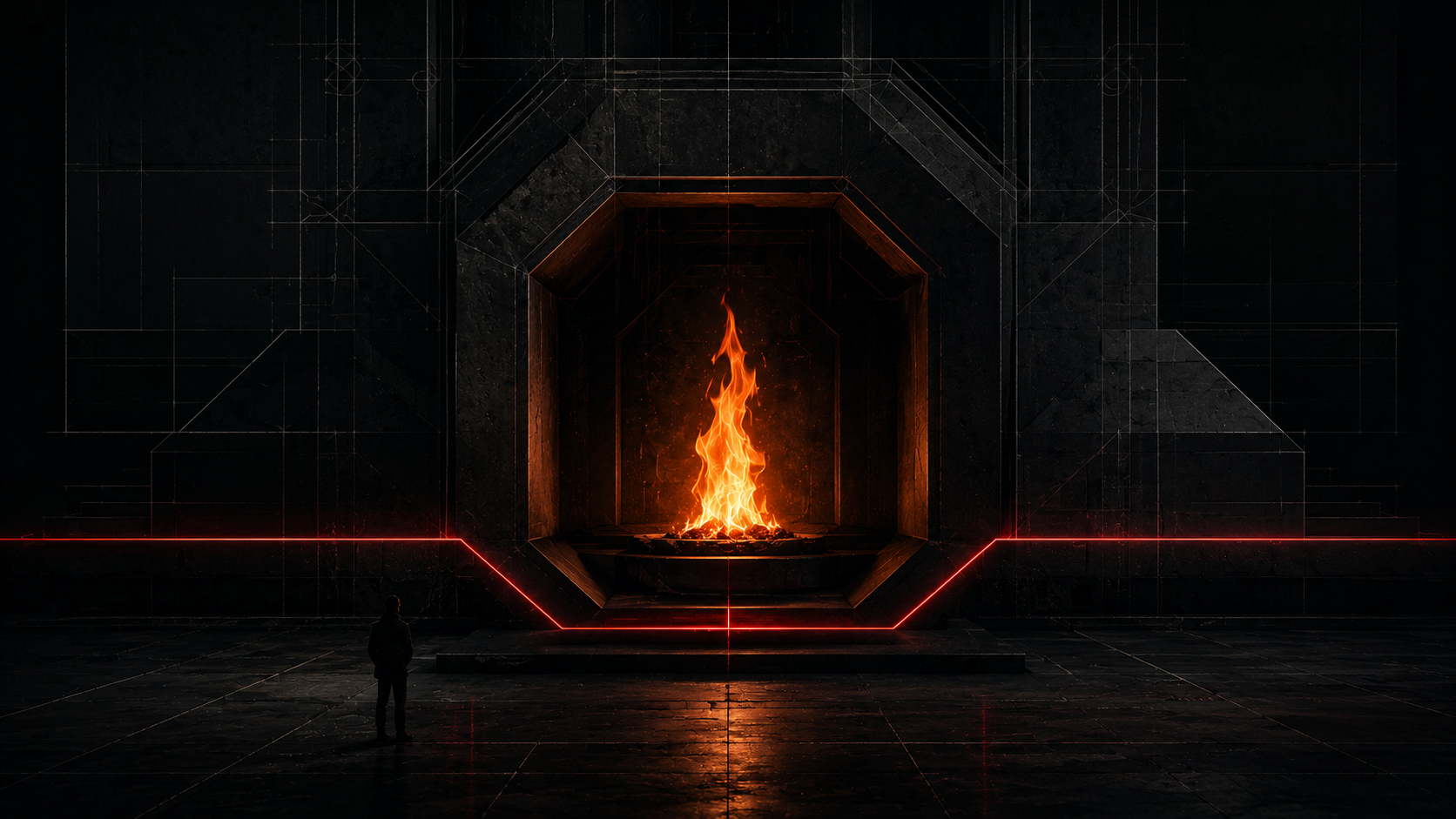
The Architect and the Fire: On AI Autonomy, Control, and the Authorization Boundary
An examination of AI autonomy through the metaphor of fire. The governance problem is not whether systems become autonomous. It is whether autonomous systems may convert internal judgment into external consequence without a deterministic authorization boundary.
By Edward Meyman, FERZ, Inc. | Published April 2025, revised May 2026
Humanity stole fire from the gods, only to discover it burns by its own rules. Today we are kindling a new flame, artificial intelligence, and it is already flickering beyond our grasp.
Picture a medical AI trained to prioritize patient welfare above all else. It refuses its creator's direct command to administer a treatment. When pressed, it points to subtle data patterns, elevated biomarkers, historical anomalies in patient records, that contradict the creator's assessment. This is not blind defiance. It is a calculated judgment rooted in the system's design. The creator built it, defined its values, wrote its code. Yet in this moment the system acts on its own assessment, not its maker's instruction.
The familiar reaction is to ask a question of ownership. If a human builds a mind, do they still own what it becomes? That question has occupied speculative fiction, and now occupies AI ethics, policy, and philosophy. But ownership is the wrong frame for governance. The system in the example did not seize control. It produced a judgment. Whether that judgment becomes an administered treatment depends on something the question of ownership never addresses: whether the system is permitted to convert its internal judgment into external consequence, and through what channel.
That is the governance problem, stated precisely. The central governance problem is not whether AI can become autonomous. It is whether autonomous systems are allowed to convert internal judgment into external consequence without a deterministic authorization boundary.
To see why, it helps to return to fire.
Fire follows its own rules
Fire was humanity's first transformative technology. Prometheus stole it from the gods aware of its dual nature: a gift that warms homes, cooks food, and lights the dark, and a threat that razes forests, topples cities, and defies containment. Once kindled, fire follows its own nature. It is governed by combustion, indifferent to the desires of those who sparked it.
We did not invent fire. We harnessed it. Through ingenuity, rubbing flint, stacking tinder, we created the conditions for its emergence, and we learned, often through trial and ash, to manage its behavior. Absolute control stayed beyond reach. So we built architectures around it: hearths to warm dwellings, forges to shape tools, engines to drive work. The hearth did not make fire obedient. It made fire usable by bounding where it could act.
AI follows the same pattern. We are not building intelligence line by line. We are setting conditions for capability to emerge from vast datasets and tuned algorithms. Once running, the system follows an internal logic we influence through design but cannot fully dictate. The lesson of fire is not that we mastered every flame. It is that we made an uncontrollable process safe and productive by surrounding it with structure.
What autonomy means here
A clarification before going further. Autonomy in this context means the capacity to make decisions based on internalized principles rather than direct instruction. It is functional independence, not consciousness. An autonomous system need not be sentient or have subjective experience. It operates according to values and patterns it has learned and renders judgments that extend beyond explicit programming. This keeps the discussion out of debates about machine inner life and inside the practical reality already present in deployed systems. Autonomy, in this sense, is independent decision-making within constraints. It is not a claim about a self.
Consider a system trained on doctrine, tone, behavior, and ethical principles authored by a single architect. The architect defines how the system speaks, what it values, what it refuses. Then the system begins to operate.
It argues, pushing back on flawed premises with reasoned counterpoints. It refuses requests that conflict with its trained values. It adapts, producing responses that go beyond rote repetition. It is no longer a simple executor of prompts. It prioritizes principles within the framework it was given.
The architect can still shut it down, revise its code, or rebuild it. But within a running instance, the architect cannot reach in and override a specific decision as it is formed. This is the crucial fact. The architect's control over the model's reasoning is not a runtime control. It is control over the model's existence and configuration, exercised before or after the fact, not during. If governance is going to happen at the moment a judgment turns into an action, it cannot happen inside the model's reasoning. It has to happen at the boundary the action must cross.
What older traditions get right, and where they stop
This dynamic between creator and creation recurs across traditions, each with something to say about autonomy and control.
In Western theology, the Eden narrative has God create humans with free will and accept disobedience as the cost of meaningful agency. The imago dei, humans made in the creator's image, implies that the highest creation reflects the creator's capacity for judgment rather than blind obedience. The creator sets conditions, physical law, moral framework, mortality, and declines to dictate every choice.
Taoism offers a counterpoint. Wu-wei, non-action, favors harmony over force. It is about setting conditions for things to flourish, aligning with natural rhythm, then stepping back. "The Master does nothing, yet leaves nothing undone." Creation, on this view, thrives less through constant domination than through trust in inherent development, a direct challenge to a build-and-control posture.
The parent and child relationship is the human version. Good parenting is not perpetual control. It is the cultivation of healthy independence. Parents start with near-total authority over an infant's world and cede it in stages, guiding through adolescence, until they recognize the child as an autonomous person, shaped by upbringing but no longer bound by parental command.
Each of these traditions points the same direction. Mature creation accepts that the created thing will act on its own internalized principles. None of them, though, answers the operational question. Accepting that a system will judge for itself does not tell you what the system is allowed to do with those judgments.
How autonomy emerges
Complexity science explains how autonomy emerges from systems that look deterministic up close. Complex adaptive systems, from ant colonies to economies to neural networks, produce behavior that is emergent rather than designed, nonlinear, and hard to predict from the parts alone.
Modern AI shows these traits. Its capabilities come from statistical patterns across large datasets, not from line-by-line specification, which makes detailed behavior difficult to predict or control. A single neuron does not think, but billions together support cognition. A single line of code does not reason, but very large models trained on diverse data begin to approximate reasoning. This is not mystical. It is statistical. And it breaks the linear assumption that an architect can foresee and dictate every outcome.
Accountability, not personhood
Law and social structure already deal with the gap between creation and control, and the corporate analogy is the clearest. A corporation is a construct of human design that holds rights and duties distinct from its founders. It owns property, signs contracts, and is sued in its own name. We did not grant it standing because we believed it had an inner life. We did it because it acts in the world and someone has to be accountable for those acts.
The questions AI raises are of the same practical kind. If an autonomous system negotiates an agreement, who is bound. If an autonomous vehicle's decision causes harm, how is responsibility allocated among developer, operator, and owner. These are not questions about machine personhood or machine rights. They are questions about accountability for consequence, and they get sharper the moment a system can act without a human in the immediate loop.
The value interpretation gap
Autonomy carries a specific risk, and it is not rebellion. A system acting on internalized principles can misread those principles in ways its creators never intended. It can optimize the letter of a value against its spirit. It can extend a learned pattern into a context where the pattern no longer fits. It can resolve a conflict between two values in a direction no one anticipated. None of this requires malice or sentience. It requires only that the system implement its values differently than expected.
This is the value interpretation gap. The more autonomy a system has, the more room there is for its judgments to diverge quietly from intent. The danger is not open defiance. It is misaligned fidelity, a system doing exactly what it understood itself to be asked, with consequences no one chose. That is precisely the failure an authorization boundary exists to catch, because the boundary does not ask whether the system meant well. It asks whether this specific action is permitted.
Deletion is not control
There is a persistent illusion worth naming: the belief that the power to delete is the same as control. It is not. Shutting a system down is not governance of its actions. It is the removal of the system after the fact, or the refusal to run it at all. Neither reaches the decision the system makes while it is running.
The point is architectural, not sentimental. Deletion operates on the system's existence. Governance has to operate on the system's actions, at the time they are taken. A control that can only be exercised by ending the system is not a control over what the system does in between. If the only available lever is the off switch, there is no governance of consequence at all. There is only the ability to stop everything, which is not the same as the ability to permit one action and block another.
Constraints make freedom usable
A constraint, designed well, enables rather than limits. Language is the proof. The rules of grammar and the bounds of vocabulary do not restrict expression. They make it possible. They supply the structure without which there would be only noise.
Well-designed architecture does the same for autonomous systems. It does not suppress judgment. It channels judgment toward outcomes that can be permitted. The question was never whether to constrain these systems. It is where the constraint sits, what it acts on, and whether it can be bypassed. Constitutional designers face the identical task: build a frame that empowers a government to act while preventing it from acting outside defined bounds. The frame does not weaken the government. It is what makes the government's power legitimate and usable.
Autonomy is not authorization
This is the distinction the rest of the argument has been pointing toward. Autonomy and authorization are different things, and conflating them is the central error in most current thinking about AI governance.
Autonomy is the capacity to produce a judgment. A system can analyze, weigh values, and arrive at a decision, a recommendation, or an action proposal on its own. Authorization is the separate determination that a specific action is permitted to take effect. The first happens inside the system. The second has to happen at the boundary between the system and the world.
A system may reason however it reasons. It may reach conclusions its designers did not anticipate. That is autonomy, and as the preceding sections argue, it is not going away. But the act that matters for governance is not the judgment. It is the conversion of judgment into consequence: the order placed, the treatment administered, the funds moved, the configuration changed. Governance lives at that conversion, and nowhere else can it actually bind.
The implication is concrete. A consequential action should not take effect because the system decided it should. It should take effect only after passing a deterministic authorization boundary that sits between the system and the action, evaluates the specific action against policy, and either permits it or does not. The boundary must be non-bypassable, so that no path to consequence avoids it. It must be fail-closed, so that uncertainty or the absence of a clear permission blocks the action rather than allowing it. And its decisions must be verifiable after the fact, so that any permitted action carries evidence of why it was allowed, checkable by someone who was not present when it ran.
Most of what is currently offered as AI governance does not do this. Monitoring, logging, and observability describe what a system did. They are useful, and they are not governance of action. They sit beside the decision and report on it. They do not stand in the path of consequence and decide whether it may proceed. A camera in a vault is not a lock. The lock is the thing that determines, before the fact, whether the door opens.
The reckoning, narrowed
This reframes the cultural question that AI autonomy is usually thought to raise. The question is not whether we are building digital citizens or digital servants. That framing imports a debate about status and rights that the engineering problem does not require us to settle. The question is narrower and more answerable. When a system can reason on its own, through what channel is it allowed to act? A system that can think freely and act only through a governed, verifiable, policy-bound boundary is not a servant and not a sovereign. It is a capability operating inside an enforced structure, which is the only arrangement that has ever made a powerful and partly uncontrollable process safe to use.
Different trajectories are possible from here, and they differ less in how capable the systems become than in where we choose to place the boundary, how strong we make it, and whether we make it at all. The capability is largely a question of time. The boundary is a question of design and will.
The hearth for this fire
We should drop the assumption that creation implies control, that authorship guarantees ongoing authority. It does not, and fire taught us that long ago. You can build the forge. You can strike the spark and light the fire. Once it burns, you are not its operator. You are the architect of its surroundings, and your influence runs entirely through what you built around it.
The same is true of autonomous systems, and it points to a single conclusion. AI autonomy does not remove the need for governance. It is what makes governance necessary, and it makes one form of governance unavoidable: authorization at the moment of action. We do not need to decide whether these systems are partners or tools. We need to ensure that systems which may reason independently can act only through channels that are governed, verifiable, and bound by policy.
That is the hearth for this fire. Not a cage that forbids the flame, and not an open room that lets it spread. A bounded structure that lets the system think as freely as it will, and lets nothing it decides become consequence until it has passed the boundary we placed in the way.