Looking Like a Vault Door Is Not the Same as Being One
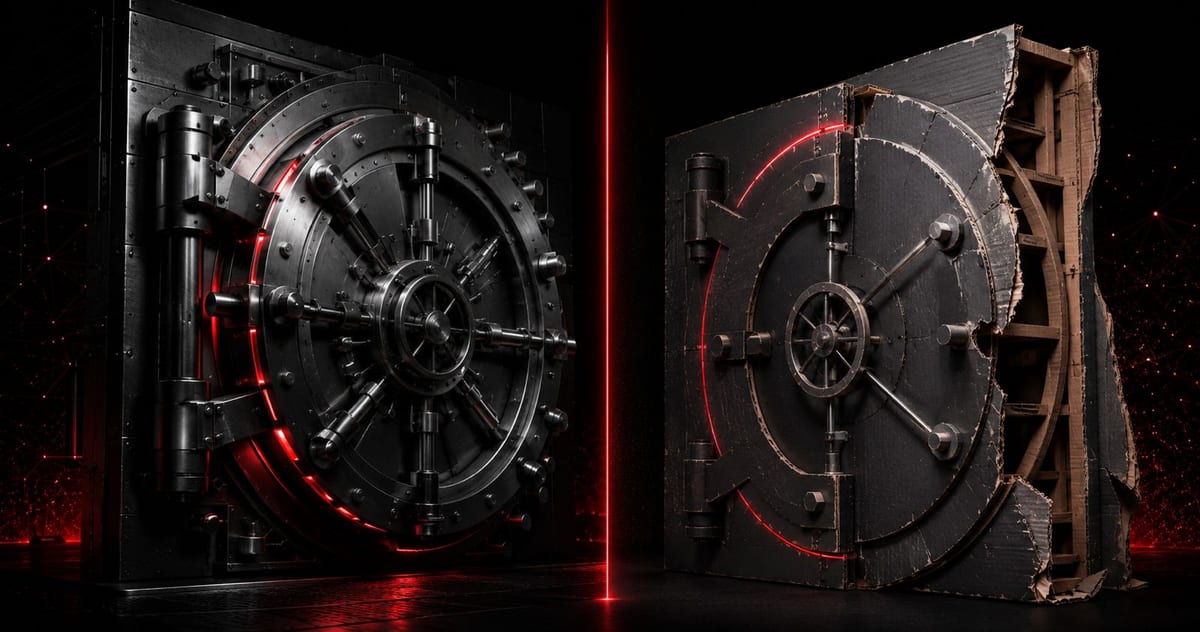
A buyer's inoculation against deterministic lip service in AI governance.
Look at the image. One of these is a vault door. The other is cardboard painted to look like one. Right now, in the AI governance market, both are being sold under the same word.
This article is for the buyer who has to tell the difference. Not next year. This quarter.
The word "deterministic" has stopped being an architectural commitment and started being a sticker. So has "runtime." So has "enforcement." So has "fail-closed." Vendors with very different architectures have arrived at very similar slide decks. The decks all look like the vault on the left. Some of the products are the cardboard on the right.
That is the problem. Not personalities. Not market noise. Architecture.
Here is the inoculation.
Six patterns of deterministic lip service
The "deterministic" sticker on a probabilistic core. If the system's compliance decision is produced by an LLM scoring the action against a policy text, the system is not deterministic. It is a probabilistic estimator with a confident voice. A second LLM checking the first one is two estimators, not a proof.
The post-hoc gate. A system that watches the action after execution and raises an alert is forensics, not authorization. A burglar alarm is not a vault door. The actor has already left with the contents.
The orchestrator dressed as enforcement. A workflow tool with conditional branches is not an execution boundary. If the branch can be reconfigured by the same agent being governed, the boundary is fictional. A door the resident can move is not a door.
The dashboard that calls itself a control plane. A console that lets a compliance officer author rules is a user interface. The question is what happens when the rule fires. If the answer is "we log it and email someone," that is reporting, not authorizing.
Fail-open sold as fail-closed. If the evaluator times out, errors, or returns low confidence, what does the system do by default? Permit action with a flag, or block action pending override? A system that ships with the first behavior has not failed safe. It has failed convenient. The brochure says fail-closed. The runtime does not.
The artifact that cannot be reconstructed. "We have full audit logs" is not the same as "any third party, given the same inputs and the same encoded constraints, can replay any past decision and arrive at the same verdict." If the only proof lives inside the vendor's own system, the proof is hostage.
If the system you are evaluating shows two or more of these patterns, you are looking at the cardboard one.
One clarification, because it is the most common deflection
Deterministic does not mean simple. It does not mean static. It does not mean a hand-written if-then list from 2012. A deterministic decision procedure is reproducible: same inputs, same encoded constraints, same verdict, every time. The constraint set itself can be rich, layered, domain-specific, and continuously updated. What it cannot be is a guess.
The four properties that have to be there
A real execution-time authorization layer has four properties. They are not opinions.
Non-bypassable. The decision sits on the execution path itself. Nothing the model, the agent, or the integration can do reaches the action without the gate having returned a verdict first.
Deterministic verdict space. A bounded set of outcomes downstream systems can rely on. ALLOW. DENY. ABSTAIN with explicit fail-closed escalation. No "scores." No "confidences." No "we noticed this."
Independently reconstructable. The decision produces an artifact a third party can replay without access to the vendor's runtime. Same inputs, same encoded constraints, same verdict. If the artifact cannot be reproduced outside the system that issued it, it is a screenshot, not a proof.
Fail-closed by design. When the gate cannot reach a confident verdict, execution is blocked pending authorized human override. The default direction under uncertainty is stop, not proceed.
These four properties are the architectural minimum under which the word "governance" is honest.
The diagnostic questions
Five questions. None of them are aggressive. All of them are diagnostic. If a vendor cannot answer them in plain language, the answer is the answer.
Where on the execution path does the authorization decision sit, and what guarantees that no code path bypasses it?
What is the verdict space, and what happens when the system cannot reach a verdict?
Can a third party, without access to your runtime, reconstruct any past decision from the artifact alone?
When the evaluator fails, does execution stop, or does execution continue?
Is the core decision produced by a deterministic procedure over encoded constraints, or by a model scoring intent against text?
A vendor that cannot answer these clearly has not failed a marketing test. It has failed an architectural one.
The conceptual center
A monitoring system may look operationally sophisticated. A policy engine may appear restrictive. A workflow gate may appear authoritative. But if execution can proceed without a deterministic, independently reconstructable authorization boundary, the system has not solved execution governance. It has produced governance theater in the language of enforcement.
Why this matters now
Regulated buyers in healthcare, financial services, and government are about to deploy AI in environments where action consequences are real and irreversible. If the governance layer is the prop, the consequences land on patients, on counterparties, and on the public. They do not land on the brochure.
The category needs a higher floor, not a louder vocabulary. The four properties and the six patterns above are the floor. They are testable. They are falsifiable. They are how the buyer tells the door from the prop.
The vault door on the left of the image is heavy because the physics of stopping a thing requires mass and structure. The replica on the right is light because it does not have to stop anything. In the photograph, in the right light, from the right angle, they look the same.
In the deployment, they do not.
Further reading
The four properties, the six patterns, and the diagnostic questions in this article are developed at length in the FERZ AI Governance Buyer's Guide (v3.2), which expands them into a procurement framework for regulated industries. Available at ferz.ai/buyers-guide. Concept DOI: 10.5281/zenodo.18002693.