Knowledge Graphs Organize Truth. FERZ Enforces It.
Knowledge Graphs organize truth. FERZ adds deterministic governance that blocks unauthorized release and produces auditable, replayable decision records at the point of release.
For over a decade, Knowledge Graphs (KGs) have been the backbone of semantic AI systems. They map entities, relationships, and rules into structured networks, providing a shared source of truth across industries as diverse as healthcare, finance, and defense. KGs are explainable, queryable, and auditable. These features made them essential long before the arrival of generative AI.
But as enterprises turn to large language models (LLMs) and retrieval-augmented generation (RAG), the limits of KGs have become clear. They store and connect facts, but they do not govern outputs. They cannot guarantee that what a system says, or refuses to say, aligns with compliance, safety, and regulatory requirements.
This is where FERZ technology steps in.
Where Knowledge Graphs Excel
Knowledge Graphs remain indispensable for:
- Semantic clarity: Entities and relations are explicitly defined.
- Consistency: Queries over the same graph yield the same results.
- Explainability: Every fact traces back to a path or ontology rule.
- Interoperability: KGs serve as the lingua franca between disparate systems.
In other words, KGs give us maps of truth.
But they stop short of enforcing truth conditions when those maps are invoked in real-world AI systems.
Where FERZ Complements Knowledge Graphs
FERZ is not a replacement for Knowledge Graphs. It is deterministic authorization infrastructure that sits in front of LLMs, RAG pipelines, and KGs alike. Its purpose is simple:
- Normalize inputs into canonical form.
- Validate evidence (whether from a KG, document store, or vector database).
- Apply domain constraints that must be satisfied before an output is released.
- Abstain by design when validation fails.
- Generate audit trails that regulators and auditors can replay step by step.
Evidence validation is not a formality. Authorization that cannot establish the provenance of its inputs is authorization in form, not in substance. Evidence must be attributable, reproducible, and traceable to an approved source before it can support release.
This is the leap from semantic knowledge to deterministic governance.
Where KGs explain the data, FERZ explains the decision.
Determinism at the Point of Release
Most AI stacks today can promise consistency only in retrospect, via logging, monitoring, or human review. This distinction is formalized in FERZ research on observability-based authorization: systems that rely on monitoring, logging, or retrospective review can demonstrate what occurred, but they cannot authorize an action before execution. Authorization and observation are distinct architectural functions (see On the Impossibility of Observability-Based Authorization, Zenodo DOI 10.5281/zenodo.19647542).
FERZ shifts this forward into the output stage itself.
- Under governed conditions, identical inputs produce the same authorized release decision, or no release at all.
- Released claims can be traced to their governing evidence and authorization record.
- Domain policies are enforced before release, not after.
In practice, this means: a hallucinated clinical claim is blocked before release; an overstated financial summary does not pass; a compliance report with unverifiable claims is denied or abstained.
Integration in the Enterprise
FERZ wraps around existing stacks:
- KG-grounded Q&A: Claims are bound to KG subgraphs; discrepancies trigger abstention.
- Master data management: Updates are accepted only if they conform to linguistic and policy templates.
- Clinical or regulatory memos: Each statement must validate against a KG or approved corpus; release is blocked otherwise.
- RAG+KG hybrids: KG evidence is weighted as "strong," RAG passages as "weak," requiring corroboration.
The result is not disruption but reinforcement: "Keep your KG. Put FERZ in front of it."
Why This Matters Now
Enterprises and regulators are moving beyond probabilistic outputs. In healthcare, finance, and government, "close enough" is not compliant enough.
FERZ delivers what KGs cannot:
- Determinism by design
- Abstention as a first-class behavior
- Formal governance hooks aligned with regulatory expectations
- Proof of compliance embedded in every released output
Bottom Line
Knowledge Graphs organize truth. FERZ enforces it.
Together, they create systems that are not only intelligent and explainable, but also auditable, compliant, and safe for mission-critical use.
In a world where knowledge alone is not enough, governance is the differentiator. That's the FERZ advantage.
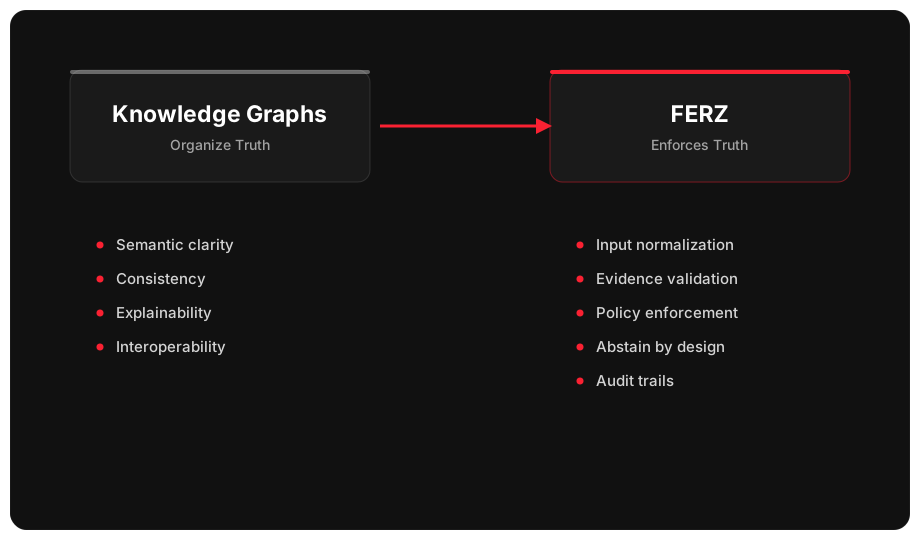
Figure 1. Comparison of Knowledge Graphs and FERZ. Knowledge Graphs organize truth by providing semantic clarity, consistency, explainability, and interoperability. FERZ enforces truth by normalizing inputs, validating evidence, applying domain constraints, abstaining when conditions fail, and producing audit trails. Together, they transform AI outputs from "best effort" into deterministic, auditable, and compliant behavior.
Why RAG + KG Isn't Enough
RAG (retrieval-augmented generation) combined with Knowledge Graphs is often presented as the answer to hallucination. By grounding model outputs in evidence and schema, the architecture can reduce risk. But reducing risk is not the same as enforcing determinism.
At best, RAG+KG pipelines simulate constraint by steering models toward likely facts:
- Retrieval narrows context.
- KGs ensure entity and relation consistency.
- Validators can check whether triples exist in the ontology.
Yet several weaknesses remain:
- Validation happens post-hoc, not pre-release.
- LLMs can still generate guesses around retrieved snippets.
- Abstention is not guaranteed; hallucinations still escape.
- Rules are local to graph schema, not systemic for compliance.
- Traceability is partial, not a full release-path audit.
These weaknesses share a root cause. A pipeline that decides which evidence is strong enough, what to surface, and what to withhold is already making authorization decisions, whether or not its designers name them as such. Performed through retrieval heuristics and confidence thresholds, that authorization has the appearance of a release boundary without its properties: it is not non-bypassable, it does not fail closed, and it cannot establish the provenance of what it admits. This pattern, implicit authorization, and why it cannot satisfy the conditions authorization requires, is treated in The Authorization Trap.
FERZ takes a different stance. It does not steer; it governs:
- Governance occurs before output is released.
- Abstention is a first-class output when validation fails.
- Enforcement applies across domains, not just ontologies.
- Every step generates a release trace for auditability.
These behaviors align with the Four Tests Standard (4TS), which evaluates whether an AI governance architecture can stop execution, establish ownership, replay decisions, and support escalation through abstention (SSRN DOI 10.2139/ssrn.5688982; spec at github.com/edmeyman/4ts-standard).
This makes FERZ fundamentally distinct. RAG+KG pipelines can reduce risk. FERZ blocks unauthorized release at the point of release.
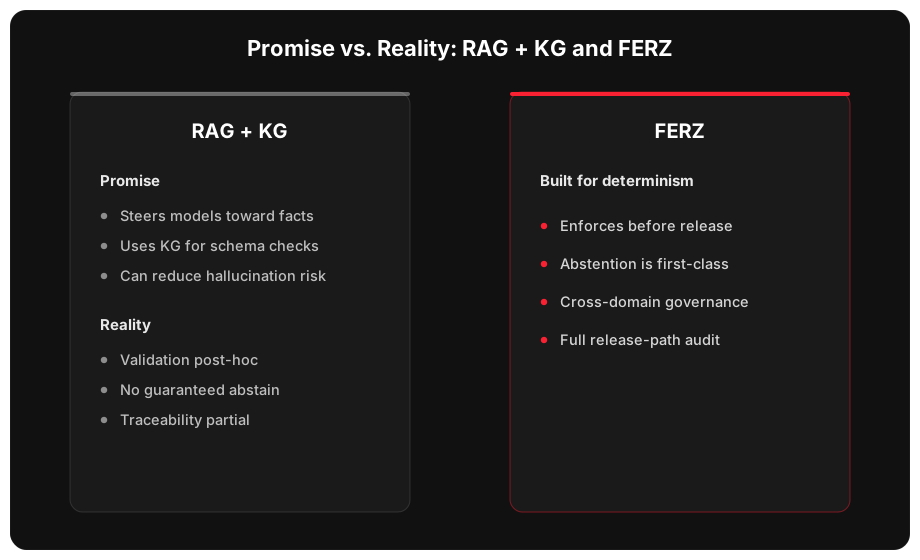
Figure 2. Promise vs. reality of RAG + KG compared to FERZ. While RAG+KG pipelines can steer outputs toward evidence and reduce hallucination risk, their checks are post-hoc, abstention is not guaranteed, and traceability remains partial. FERZ, by contrast, enforces governance before release, treats abstention as a first-class behavior, applies cross-domain policies, and generates full release-path audits, making determinism intrinsic rather than optional.