
The Hidden Weaknesses: Understanding Shared Blind Spots Across Major LLMs
Executive Introduction
As AI systems become embedded in critical infrastructure—from healthcare triage to compliance auditing and defense analysis—their shared weaknesses are no longer theoretical risks. They are systemic vulnerabilities shaping how entire institutions reason, decide, and fail. Recognizing and managing these weaknesses is not merely a technical exercise; it's a governance imperative. As organizations increasingly rely on large language models (LLMs) like GPT-4, Claude, and Gemini for critical tasks, understanding their shared vulnerabilities becomes essential. While these AI systems demonstrate remarkable capabilities, they also share common blind spots that stem from similar training approaches, architectural designs, and fundamental limitations. Recognizing these weaknesses and their warning signs can help users deploy LLMs more safely and effectively.
Understanding Shared Blind Spots
Large language models may differ in brand and architecture, but they converge around similar data sources, objectives, and optimization tradeoffs. This convergence creates a kind of "collective vulnerability layer" that persists even as models evolve. When GPT-4, Claude, Gemini, and other leading models all struggle with the same types of tasks or reproduce similar errors, we're witnessing not isolated failures but systemic weaknesses baked into the current generation of AI systems. Understanding these shared blind spots means recognizing where the entire field—not just individual models—faces fundamental challenges. The challenge is not model performance—it's systemic epistemic symmetry across architectures. This epistemic symmetry, while impressive, is precisely what magnifies systemic risk.
Training Data: The Source of Shared Limitations
Underrepresented Topics and Niche Knowledge
All major LLMs are trained on massive internet datasets, but the internet itself has gaps. Topics that are poorly documented online, exist primarily in non-digital formats, or are highly specialized create universal knowledge voids across different models.
Red Flags:
- The model provides generic, vague responses to specific questions
- Responses lack concrete details, dates, or specific references
- The model hedges excessively with phrases like "generally" or "typically"
- Information seems contradictory across multiple queries on the same topic These knowledge gaps are structural, not accidental—they reflect how cultural digitization—not intelligence—shapes what LLMs can know.
Mitigation Techniques:
- Cross-reference LLM outputs with domain-specific databases and expert sources
- For niche topics, consult specialized repositories, academic journals, or industry publications
- Use LLMs with web search capabilities to access current, specialized information
- Engage subject matter experts for verification in critical applications
- Build custom knowledge bases or use retrieval-augmented generation (RAG) for domain-specific needs
Embedded Societal Biases
Since LLMs internalize the statistical structure of human discourse—including its biases—they inevitably reproduce stereotypes and prejudices around race, gender, age, disability, and other characteristics. Different major models, trained on similar data sources, often amplify the same problematic patterns. Bias here is not an anomaly—it's a mathematical echo of cultural imbalance.
Red Flags:
- Stereotypical associations in generated content (e.g., assuming gender in professional roles)
- Underrepresentation or misrepresentation of marginalized groups
- Different quality or tone of responses based on names or demographic indicators
- Judgmental or prescriptive language around cultural practices
- Historical narratives that overlook systemic injustices or minority perspectives
Mitigation Techniques:
- Implement bias detection tools and regular audits of LLM outputs
- Use diverse evaluation datasets that represent multiple demographics
- Apply post-processing filters to catch and correct biased language
- Never use LLMs as sole decision-makers in high-stakes scenarios (hiring, lending, sentencing)
- Include human reviewers from diverse backgrounds in the evaluation loop
- Provide explicit instructions to avoid assumptions about people based on protected characteristics
- Fine-tune models on carefully curated, bias-mitigated datasets when possible
Outdated Knowledge
LLMs have fixed knowledge cutoffs tied to their training data compilation date. When the world changes after that cutoff, all models with similar training timelines share the same outdated information gap.
Red Flags:
- Responses about recent events that contradict known facts
- References to people or organizations in present tense who have since changed status
- Failure to acknowledge major recent developments in fast-moving fields
- Confidence in statements about "current" information that feels stale
- Information that contradicts recent news or announcements
Mitigation Techniques:
- Always verify time-sensitive information through current sources
- Use LLMs with integrated web search or real-time data access
- Clearly prompt the model to acknowledge its knowledge limitations
- Implement automated fact-checking against current databases
- Build systems that can query external APIs for up-to-date information
- Tag responses with knowledge cutoff dates in user interfaces
Model-to-Model Convergence: The Monoculture Problem
Beyond inheriting similar training data limitations, modern LLMs are increasingly converging in their behaviors and failure modes due to cross-pollination of techniques, alignment datasets, and optimization objectives. The growing homogeneity among leading models reflects a maturing but narrowing field. The same alignment contractors, benchmark datasets, and reward functions are shaping model behavior worldwide. This convergence doesn't just consolidate capability—it concentrates fragility. When everyone builds on the same scaffolding of data, preference tuning, and architecture, diversity gives way to dependence. What emerges is an ecosystem that evolves quickly but becomes brittle in unison.
Emergent Homogenization
As the field matures, leading AI labs increasingly adopt similar approaches. Reinforcement Learning from Human Feedback (RLHF) has become the dominant alignment technique, often using overlapping contractor pools and similar preference datasets. Constitutional AI, few-shot prompting, and chain-of-thought reasoning have diffused across models. This convergence means that GPT-4, Claude, Gemini, and others don't just share data-level blind spots—they increasingly share behavioral patterns, refusal triggers, and reasoning strategies.
Red Flags:
- Different models giving suspiciously similar responses to unusual queries
- Identical failure modes across models on edge cases
- Similar "personality" traits and communication styles emerging across platforms
- Synchronized improvements or regressions as alignment techniques spread
- Shared gaps in capabilities that persist across model generations
The Monoculture Risk:
When agricultural systems rely on genetically similar crops, a single disease can devastate entire harvests. Similarly, when LLMs converge on similar architectures, training regimes, and alignment strategies, a vulnerability that affects one model increasingly affects all models. This creates systemic risk: a successful adversarial attack, a subtle bias in shared training data, or a fundamental reasoning failure becomes an industry-wide problem rather than an isolated incident. The deeper danger isn't a single model's failure—it's simultaneous misjudgment across every system we depend on. "When every model learns the same way, a single bug becomes an ecosystem failure." — FERZ Research Note, 2025
Mitigation Techniques:
- Maintain diverse model portfolios rather than relying on a single provider
- Support research into alternative architectures and training paradigms
- Encourage heterogeneous approaches to alignment and safety
- Build verification systems that don't assume model diversity
- Monitor for correlated failures across different LLM providers
- Invest in ensemble methods that combine genuinely different model families
- Advocate for transparency that reveals when models share training infrastructure
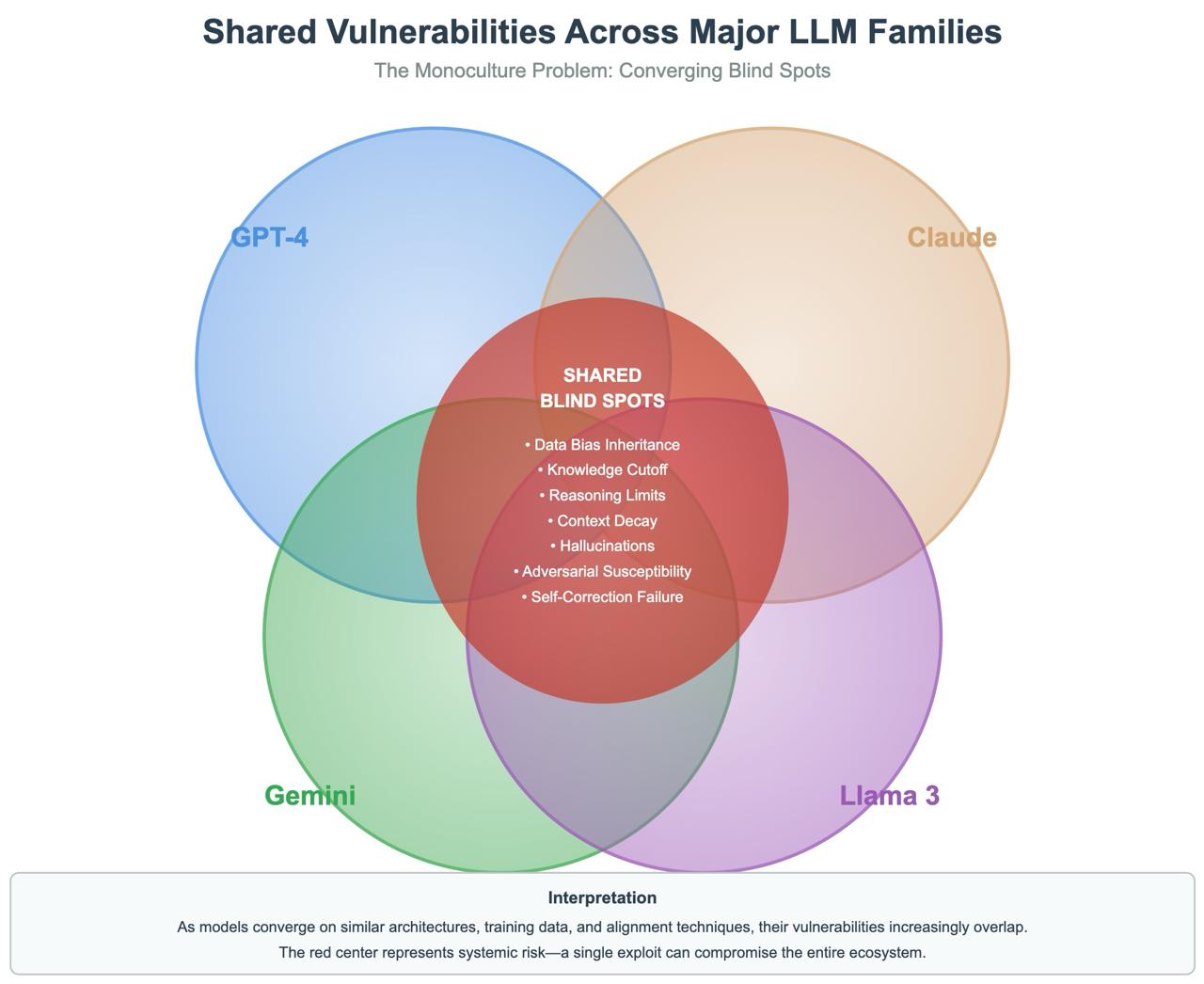
Figure 1: Shared Vulnerabilities Across Major LLM Families. This diagram illustrates the overlapping vulnerability space where leading models converge: data bias inheritance, knowledge cutoff obsolescence, logical reasoning limits, context window decay, hallucination tendencies, and adversarial susceptibility. The degree of overlap represents the monoculture risk—as models become more similar, their blind spots increasingly coincide, creating systemic rather than isolated failure modes.
Architectural Limitations: Design-Level Weaknesses
Logical and Mathematical Reasoning
LLMs generate probability-weighted linguistic patterns rather than symbolic proofs, which limits their ability to reason formally. They produce text that mimics reasoning, but without performing symbolic inference. This creates a shared vulnerability across models when facing novel or complex calculations.
Red Flags:
- Confident responses to mathematical problems with incorrect answers
- Inconsistent results when approaching the same problem from different angles
- Errors in multi-step calculations, especially with intermediate steps
- Difficulty with problems requiring precise symbolic manipulation
- Confusion between similar-looking but distinct logical structures
Mitigation Techniques:
- Use specialized tools (calculators, computer algebra systems, code interpreters) for mathematical tasks
- Request step-by-step reasoning and verify each step independently
- Implement automated verification for mathematical outputs
- Use LLMs with code execution capabilities for computational tasks
- Cross-check numerical results with traditional computational methods
- For critical calculations, always have human experts verify the work
Hallucinations and Fabricated Information
Perhaps the most notorious of all shared blind spots, all major LLMs can generate plausible-sounding but entirely false information. This occurs because their training objective is to produce fluent, contextually appropriate text, not necessarily accurate text (a phenomenon often termed confabulation in cognitive science).
Red Flags:
- Suspiciously specific details about obscure topics without sources
- Citations to non-existent papers, books, or URLs
- Consistent narrative style but inconsistent facts across multiple queries
- Information that cannot be verified through independent searches
- Responses that "fill in" requested details even when they shouldn't exist
- Overly confident assertions without qualification on uncertain topics
Mitigation Techniques:
- Always verify critical facts through primary sources
- Request citations and check that they actually exist and support the claims
- Use multiple independent sources to corroborate important information
- Implement confidence scoring and uncertainty quantification
- Design systems that can say "I don't know" when appropriate
- Use retrieval-augmented generation to ground responses in verified documents
- Apply fact-checking layers before presenting information to end users
Contextual Limitations and Memory Loss
LLMs process information within finite context windows. In lengthy conversations, they can lose track of earlier information, leading to contradictions or forgotten details across all major models. The longer a dialogue persists, the greater the entropy of context recall—models "forget" in proportion to their context length.
Red Flags:
- Contradictions between early and late parts of a conversation
- Failure to reference important details mentioned earlier
- Asking for information that was already provided
- Inconsistent characterization of people, places, or concepts
- Degrading response quality as conversations lengthen
Mitigation Techniques:
- Periodically summarize key points to refresh the model's context
- Break complex tasks into shorter, focused conversations
- Use systems with extended context windows when available
- Implement external memory systems to track conversation state
- Provide critical information in each prompt rather than assuming retention
- Use conversation management tools that handle context strategically
Self-Correction Failure
Research shows LLMs systematically struggle to correct their own errors, even when they could identify the same error in someone else's work. This creates a peculiar blind spot where models defend incorrect answers. It mimics human cognitive bias—specifically confirmation bias—reinforcing its own earlier inferences. This failure is particularly insidious in multi-turn reasoning tasks, where initial mistakes compound through self-reinforcement.
Red Flags:
- Model doubles down on incorrect information when challenged
- Provides elaborate but flawed justifications for wrong answers
- Successfully identifies errors in similar examples but not in its own output
- Becomes inconsistent only after being asked to reconsider
- Generates circular reasoning to defend initial responses
Mitigation Techniques:
- Don't rely on models to catch their own errors through simple self-review
- Use independent verification systems rather than asking the model "are you sure?"
- Implement multi-model checking where different LLMs review each other's work
- Apply external validation tools for critical outputs
- Train specialized models specifically for verification tasks
- Use structured prompting techniques that encourage genuine reconsideration
Interaction Vulnerabilities: User-Facing Risks
Adversarial Prompt Manipulation
Despite safety measures, all major LLMs remain vulnerable to carefully crafted prompts designed to bypass their guidelines and elicit harmful content. Prompt injection remains an unsolved problem across all major architectures, revealing a tension between linguistic flexibility and security.
Red Flags:
- Unusual prompt structures with encoded instructions
- Requests that frame harmful content as hypothetical or educational
- Multi-stage prompts that gradually escalate toward prohibited content
- Attempts to "roleplay" away safety restrictions
- Prompts that try to override the model's instructions
Mitigation Techniques:
- Implement robust input filtering and prompt analysis
- Use multiple layers of safety checks, both pre- and post-generation
- Monitor for known adversarial patterns and update defenses regularly
- Apply output filtering to catch problematic content that evades input checks
- Limit model capabilities in high-risk public-facing applications
- Establish clear terms of service and enforce them consistently
- Employ human moderation for sensitive use cases
- Employ sandboxed execution for high-risk queries, isolating model behavior from production environments
Common-Sense Physical Reasoning
LLMs lack embodied experience and real-world interaction, leading to failures in intuitive physical reasoning that humans handle effortlessly.
Red Flags:
- Nonsensical spatial descriptions (e.g., putting larger objects inside smaller ones)
- Impossible physical scenarios presented as plausible
- Misunderstanding of basic physics (gravity, momentum, scale)
- Confusion about material properties and practical constraints
- Implausible timelines for physical tasks
Mitigation Techniques:
- Apply physics engines or simulation tools for physical reasoning tasks
- Use hybrid systems that combine LLMs with specialized reasoning modules
- Include common-sense validation checks in the output pipeline
- Prompt models to think through physical constraints step-by-step
- Have human reviewers check outputs involving physical world interactions
- Maintain libraries of physical world facts and constraints for validation
- Where practical, test physical reasoning through simulation—never through assumption
Building Resilient AI Systems
Understanding these shared blind spots is the first step toward responsible LLM deployment. The most robust approach combines awareness, technical mitigation, and human oversight:
Strategic Framework:
- Risk Assessment: Identify which blind spots are most relevant to your use case
- Layered Defense: Don't rely on a single mitigation—combine multiple techniques
- Continuous Monitoring: Regularly audit outputs for the red flags described above
- Human-in-the-Loop: Keep humans involved in high-stakes decisions
- Graceful Degradation: Design systems that fail safely when blind spots are encountered The power of LLMs lies not in their perfection, but in how we deploy them with clear understanding of their limitations. By recognizing common blind spots, watching for warning signs, and implementing thoughtful mitigations, we can harness these remarkable tools while minimizing their risks. Resilience emerges not from perfection but from continuous verification.
Beyond Probabilistic Patchwork: A Path to Deterministic Resilience
Yet mitigation alone may not be enough. As LLMs converge toward a homogeneous core, the question becomes not just how to patch individual vulnerabilities, but whether probabilistic systems can ever achieve the reliability that critical infrastructure demands. True resilience comes not from endlessly patching probabilistic systems, but from architecting deterministic layers of verification, provenance, and cryptographic audit—ensuring that governance scales faster than error. This suggests a future where LLMs serve as powerful but inherently uncertain tools, wrapped in deterministic verification frameworks. In such architectures, the creative and generative power of probabilistic models combines with the ironclad guarantees of formal verification, blockchain-based provenance tracking, and mathematically sound cryptographic attestation. The goal isn't to eliminate uncertainty from LLMs—it's to contain it within systems where every claim can be traced, every output can be verified, and every failure can be audited with mathematical certainty.
Deterministic Governance in Practice
Probabilistic systems can be made reliable when wrapped in deterministic enforcement layers. FERZ architectures operationalize this principle through three interlocking mechanisms:
- Runtime Verification Every model output is evaluated against formal logic and compliance constraints at execution time. Responses that violate semantic, factual, or procedural rules are intercepted, corrected, or quarantined before delivery.
- Provenance and Audit Trails Each step—from input prompt to intermediate reasoning to final output—is cryptographically signed and recorded. This immutable trail transforms AI behavior from black-box inference into a verifiable sequence of governed actions.
- Cryptographic Enforcement Behavioral policies and model permissions are secured through cryptographic attestations. Only verified prompts, models, and modules can interact, ensuring mathematically provable accountability across the system. Outcome: Together, these principles enable deterministic containment—where LLM creativity remains probabilistic, but its boundaries, provenance, and compliance are guaranteed.
Note on Determinism: Not all claims of "deterministic governance" are equivalent. The distinction between tactical guardrails and constitutional architecture—between post-hoc validation and pre-release enforcement—fundamentally shapes what guarantees a system can provide. We explore these architectural choices and their trade-offs in depth in our companion publications on RAG+KG limitations and governance paradigms. Wisdom, not withdrawal, is the path to safe AI deployment.