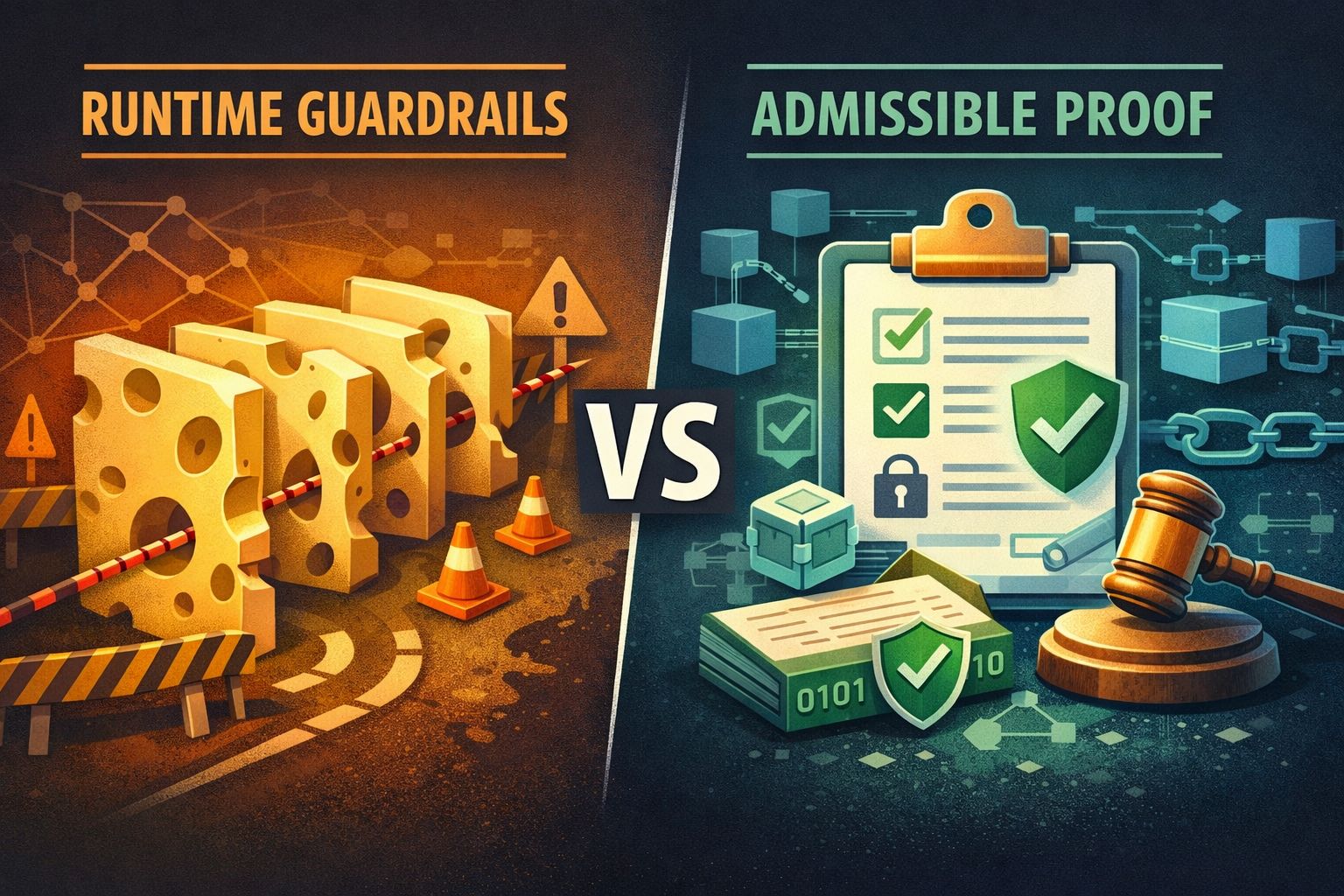
Guardrails vs. Proof: The Missing Axis in Multi-Layer Agent Safety
Edward Meyman, Founder & CEO, FERZ, Inc.
January 2026
The industry is converging on a useful insight: if you're building agentic systems, safety cannot live at the perimeter. Guardrails have to operate across goals, plans, tools, memory, intermediate states, and outputs—not just at the prompt or response layer. Recent taxonomy work on multi-layer runtime guardrails—across both academic literature and industry tooling—reflects that maturation. It's a real step forward.
It's also incomplete in a way that matters if you operate in regulated environments.
Here's the hinge: guardrails are not the same thing as proof.
Most contemporary frameworks treat traceability as the end state. You log what happened. You retain execution traces. You preserve tool calls, intermediate reasoning artifacts, and outputs. After an incident, you reconstruct the story.
That's observability. It's not evidence.
In regulated contexts, the question you face later is not "can we explain what the system did?" It's "can a third party independently verify that authorization was functioning at the moment the decision was made?" Different problem.
What the taxonomy gets right
The current generation of guardrail frameworks correctly rejects single-layer thinking. They decompose agent behavior across multiple control surfaces: objectives, context, planning, tool invocation, intermediate reasoning, final actions. They acknowledge that failures propagate across layers, and that redundancy matters.
They also correctly treat guardrails as runtime mechanisms, not static policy statements. Enforcement during execution is the point.
On architecture alone, this is progress.
Where the framework quietly stops short
The problem is not what these taxonomies include. It's what they implicitly assume.
When "traceability" is defined as logs, audit trails, or execution records, the framework collapses evidence into instrumentation. The assumption is that if you can reconstruct the execution path later, governance has been satisfied.
That assumption does not survive contact with regulatory scrutiny.
Logs can tell you what happened. They do not prove what was authorized.
They are mutable. They are operator-controlled. They require trust in the system that generated them. And critically, they do not allow an external party to replay the authorization logic against the preserved state and reach an independent conclusion.
In other words: logs support narrative reconstruction. They do not produce admissible proof.
The holes are the point
The Swiss cheese model is not a metaphor for "layers are good." It's a metaphor for "every layer has holes."
That's the defining feature. Each slice is assumed to be imperfect, with gaps that may or may not align on any given pass. Safety emerges not from any single layer being reliable, but from the statistical improbability that all the holes line up at once. You don't need to restate "there are holes" for a safety engineer to understand that's what you're invoking. It's baked into the model.
What current guardrail taxonomies do is borrow the layered defense intuition—redundancy, distribution of controls, multiple checkpoints—without confronting the implication that each layer is expected to be incomplete.
That omission matters.
By not naming the holes, the analogy quietly slides from risk mitigation into something that sounds closer to guarantee, without actually providing one. The reader is left with a reassuring image—many slices, many guardrails—without being forced to ask: What happens if one path bypasses all of them?
This is the architectural fork that determines everything downstream.
If you're designing for probabilistic safety, you tolerate holes and manage alignment risk. You accept that no single layer is perfect, and you engineer for aggregate reliability. That's a legitimate design posture for many contexts.
If you're designing for evidentiary governance, holes aren't a background assumption—they're a failure condition. The question isn't "how unlikely is full bypass?" It's "can we prove, for this specific decision, that authorization was enforced?" Probability doesn't answer that question. Only deterministic capture does.
This isn't a critique of probabilistic generation; it's a constraint on how authorization must be evidenced.
The Swiss cheese model was built for the first problem. Regulated AI deployment increasingly demands the second.
The missing axis: evidentiary grade
What's absent from most guardrail taxonomies is an explicit distinction between operational controls and evidentiary outcomes.
A useful way to state it:
Narrative-grade controls Filters, validators, monitors, human approvals, and logs that help operators manage risk and explain behavior.
Audit-grade controls Structured traces and reproducible pipelines that improve internal review and forensic analysis, but remain administratively mutable.
Proof-grade controls Mechanisms that produce a tamper-evident, third-party-replayable artifact demonstrating that authorization constraints were enforced at decision time.
Most current frameworks operate in the first two categories. They rarely define the third, and almost never require it.
That's not a philosophical gap. It's an architectural one.
What's actually missing, concretely
Several elements never quite appear in guardrail taxonomies, even when the language gestures toward "safety by design":
The decision artifact as a first-class target Not just outputs, but a normalized record of the decision state: inputs, constraints, policy snapshot, and authorization outcome.
Attestation actions, not just logging actions Cryptographic signing, sealing, and commit semantics that make post-hoc modification evident.
Fail-closed authorization semantics The inversion of the typical default: execution cannot proceed unless authorization explicitly succeeds—and that success is captured as evidence, not inferred later.
Replayability The ability for an external verifier to re-execute the authorization logic against the preserved state and validate the result without trusting the operator.
Without these, you have layered guardrails—but you don't have proof that they functioned when it mattered.
Why this distinction matters now
As agentic systems move from experimentation into regulated deployment, the burden shifts. It's no longer enough to say "we had guardrails." After something goes wrong, the question becomes whether governance can be demonstrated, not asserted.
That's where many well-intentioned frameworks will fail—not because they're careless, but because they stop at observability.
When regulators ask for proof, they're not asking how unlikely a bypass was—they're asking whether this decision can be independently validated.
Swiss-cheese safety models reduce risk. Admissible proof requires something else.
FERZ researches and develops deterministic AI governance infrastructure for regulated environments.