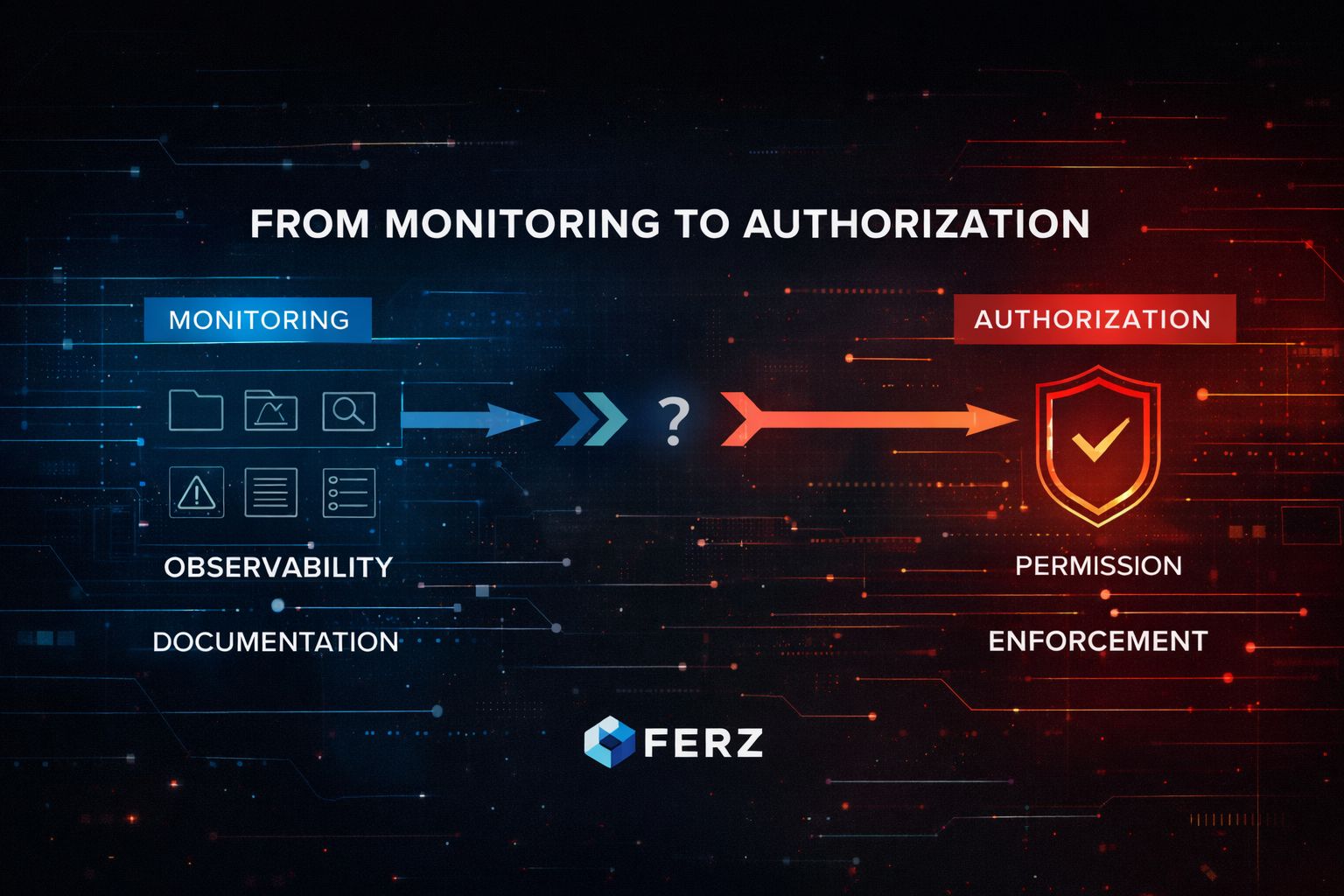
From Monitoring to Authorization: The Structural Shift Emerging in Agentic AI Governance
A cross-jurisdiction view of why monitoring-based governance cannot, by itself, meet enforcement-grade requirements for agentic AI.
Edward Meyman February 2026
I. The Convergence Moment
Agentic AI governance frameworks are becoming more detailed, more specific, and more operationally grounded. Across jurisdictions, recent regulatory consultations have produced guidance addressing risk stratification, lifecycle management, oversight mechanisms, testing protocols, and continuous monitoring. The language is improving. The frameworks are maturing.
Yet a recurring structural ambiguity persists: the difference between observing AI behavior and authorizing AI action.
This ambiguity is not a drafting oversight. It reflects the architectural assumptions of an era in which AI systems primarily generated content — text, images, recommendations — and governance meant ensuring that content met quality, safety, and fairness standards. In that era, monitoring was governance. The output was the concern, and reviewing it was the control.
Agentic AI changes the premises. When an AI system writes to a database, initiates a payment, sends a communication, or modifies infrastructure, the output is no longer content. It is a side effect. Side effects are not reviewed. They are either permitted or they are not — and the distinction must be resolved before execution, not after.
This essay extends two earlier analyses on the distinction between observability and enforcement and on the concept of the authorization boundary, situating those ideas within an emerging cross-jurisdiction regulatory context.
II. The Monitoring Era of AI Governance
The dominant governance architecture for AI systems was built for the content era. Its components are familiar: model cards, audit bundles, drift detection, escalation queues, dashboard alerts, and human review loops. Together, they form a comprehensive visibility stack — and they answer an important question: What happened?
They do not necessarily answer a different question: Was this action permitted before it executed?
This is not a criticism of monitoring. It is a distinction between observability and enforcement that has direct architectural consequences. Monitoring documents behavior. Authorization determines permission. When a monitoring system fails, it degrades to incomplete logging. When an authorization system fails — if properly designed — it halts execution. These are categorically different failure modes, and they require categorically different architectural commitments.
III. The Authorization Boundary
An authorization boundary exists when AI output cannot reach downstream systems without passing through a non-bypassable gate that evaluates policy-state binding, produces a deterministic verdict, and fails closed when evidence is incomplete.
This definition is precise because precision matters. Each element carries architectural weight. "Non-bypassable" means there is no execution path that circumvents the gate — not through error handling, not through fallback logic, not through timeout. "Policy-state binding" means the evaluation is anchored to a specific, versioned policy at a specific point in time, not to a general compliance posture. "Deterministic verdict" means identical inputs produce identical outcomes — the evaluation is reproducible. "Fails closed" means that when the gate cannot reach a verdict, the default is denial with escalation, not silent approval.
The authorization boundary is the architectural point between intent and execution where governance must reside. It is distinct from access control (which determines whether an agent can reach a resource), from content filtering (which evaluates output quality), and from monitoring (which documents what occurred). Each of these capabilities operates on a different plane, at a different point in the execution lifecycle, with different failure properties.
IV. What Regulatory Consultations Are Revealing
Reading recent governance frameworks side by side — across jurisdictions, across regulatory traditions, across threat models — a pattern emerges.
The lifecycle controls are strong. Risk assessment frameworks increasingly account for agent-specific factors: action scope, reversibility, autonomy level, task complexity, and exposure to external systems. Accountability structures are becoming more nuanced, addressing the diffusion of responsibility across multi-party value chains. Testing guidance is evolving to address agentic-specific dimensions: task execution accuracy, policy adherence, tool-use correctness, and robustness to edge cases. Monitoring recommendations are detailed, covering logging, anomaly detection, alert thresholds, and human escalation.
But the enforcement primitive remains under-specified — at the decision boundary where intent becomes effect.
Across consultations, several questions surface implicitly — not always asked directly, but structurally present in the gaps between what frameworks recommend and what regulated environments require:
What happens when governance infrastructure itself fails? If the monitoring system goes down, does execution continue? If a human reviewer is unavailable, does the output proceed? The answer reveals whether the architecture is fail-open or fail-closed — and most frameworks do not specify.
Can AI execution proceed with missing evidence? If no governance evaluation was performed on a specific action, is the absence detectable? Or does the action simply proceed without a corresponding evidence artifact? The answer reveals whether governance is a gate or a suggestion.
Can authorization be verified independently of the governed system? If a regulator or auditor asks to reproduce a governance decision, can they do so without the vendor's cooperation? Without calling the vendor's APIs? Without access to the vendor's infrastructure? The answer reveals whether governance evidence is portable or captive.
Are human overrides governed or bypasses? When a human overrides an automated governance verdict, is the override itself recorded as a governed decision with its own evidence trail? Or does the override simply remove the action from governance scope? The answer reveals whether human oversight strengthens or weakens the evidence chain.
Are cross-agent trajectories evaluated as sequences? When multiple agents interact, each within its individual authorization scope, is the composite trajectory evaluated against cross-domain constraints? Or is governance applied only at the individual action level, leaving compositional violations undetected? The answer reveals whether governance scales with system complexity.
These questions are not theoretical. They are the questions that regulated industries — healthcare, financial services, defense, critical infrastructure — will ask when agentic AI enters production at scale. The frameworks are approaching these questions. They have not yet answered them architecturally.
V. From Oversight to Enforcement
Traditional compliance relies on four mechanisms: deterrence (consequences discourage violations), accountability (responsibility can be attributed), escalation (problems reach decision-makers), and documentation (actions are recorded for review).
Agentic systems alter the premises on which these mechanisms depend.
Deterrence assumes the actor can be deterred. AI agents lack the properties that make deterrence effective — they have no stakes, no reputation, no concept of consequences. Security architectures that assume the governed entity will be influenced by the threat of punishment are structurally mismatched to autonomous systems.
Accountability assumes actions can be attributed to responsible parties. In multi-agent systems with emergent behavior, the attribution chain becomes complex. Multiple agents, multiple vendors, multiple decision points — each individually defensible, collectively ungoverned.
Escalation assumes review latency is acceptable. When agents execute thousands of actions per hour, the time between action and review becomes the window of ungovernability. Escalation remains valuable for genuinely ambiguous cases; it cannot serve as a primary control at machine speed.
Documentation assumes records are sufficient. But documentation of what happened is not equivalent to evidence that what happened was permitted. The distinction between audit logs and governance proof — between narratives requiring trust in the logging system and replayable evidence packages verifiable by any independent party — is the evidentiary gap that agentic governance must close.
Therefore, oversight must be supplemented by enforcement. This is not an argument against monitoring. It is an argument for layering.
| Monitoring | Authorization | |
|---|---|---|
| Timing | Post-execution | Pre-execution |
| Function | Evidence of behavior | Permission to act |
| Trigger model | Alert-driven | Gate-driven |
| Failure mode | Fail-open tendency | Fail-closed default |
| Evidentiary value | Process documentation | Decision-level proof |
VI. Evidence-Grade Governance
Emerging regulatory expectations presuppose capabilities that monitoring alone cannot provide: decision-level proof that a specific policy was applied to a specific action; policy-state binding that anchors governance evidence to a versioned, immutable policy at the time of evaluation; replayability that allows independent reproduction of governance verdicts; and verifier independence that ensures evidence can be assessed without the governed system's cooperation.
These expectations are not yet codified as requirements in most jurisdictions. But the trajectory is clear. When non-compliance carries material legal and financial consequence, the evidentiary question shifts from "do you have a governance process?" to "can you prove your governance process was applied to this specific decision?" That is an authorization question, not a monitoring question.
The procurement implications follow directly. Organizations evaluating governance solutions for consequential AI deployments should ask one question that separates architectural governance from a non-verifiable governance posture: Can you verify this action without relying on the vendor? If evidence verification requires the vendor's APIs, the vendor's infrastructure, or the vendor's cooperation, then the evidence is captive — and captive evidence is not independently verifiable.
VII. Compositional and Multi-Agent Risk
As systems become multi-agent, a further governance challenge emerges: individually authorized actions that produce unauthorized composite behavior.
When multiple agents interact — each operating within its individual authorization scope — the composite trajectory may violate constraints that no single action would trigger in isolation. This is the composition problem: individually correct components producing incorrect system behavior. It is well-understood in formal verification. It is not yet addressed in most governance frameworks.
Monitoring individual tool calls is insufficient to detect compositional violations. Authorization must evaluate sequences, enforce cross-agent constraints, and bind state across action chains. The tooling is nascent, but the architectural requirement is already present in any multi-agent deployment where agents share state or trigger downstream actions.
As multi-agent deployments become common, authorization properties increasingly apply to trajectories, not just single actions.
VIII. The Emerging Architectural Standard
For high-impact agentic deployments, a set of architectural properties is becoming structurally necessary. These are not vendor features. They are design questions that any governance architecture must answer:
- Non-bypassable runtime gate between intent and execution
- Deterministic verdict semantics — PERMIT, DENY, or ABSTAIN — with consistent meaning across the system
- Fail-closed default when evidence is incomplete or the gate cannot reach a verdict
- Policy-state binding anchoring each decision to a specific, versioned policy at the time of evaluation
- Content-addressed, portable evidence artifact that is self-contained and not vendor-dependent
- Independent replay capability allowing any party to reproduce the verdict without vendor cooperation
- Environment classification distinguishing authoritative (binding) from non-authoritative (non-binding) governance evidence
These questions are not prescriptive. Different architectures will answer them differently. But the questions themselves are becoming unavoidable for any deployment where the consequences of ungoverned action are material.
IX. Integration, Not Replacement
The argument for authorization is not an argument against monitoring. Monitoring remains essential: operational visibility, anomaly detection, drift measurement, incident forensics, and compliance reporting all depend on robust observability infrastructure.
The argument is for layering. Authorization provides the enforcement substrate at the execution plane. Observability provides the transparency stack above it. Together, they produce a governance architecture that can both prevent unauthorized actions and document what occurred. Neither layer substitutes for the other. A system with authorization but no monitoring is blind. A system with monitoring but no authorization is unarmed.
X. The Structural Shift
As agentic AI moves from advisory to autonomous execution, governance architectures will be judged not by how well they document violations, but by whether they prevent them.
This is not an ideological position. It is a structural observation. The shift from monitoring-era governance to authorization-era governance follows from the properties of the systems being governed: they act autonomously, they produce irreversible effects, they operate at speeds that exceed human review latency, and they lack the properties that make traditional deterrence effective. These are not policy preferences. They are engineering constraints.
The frameworks are converging toward this recognition. The architectural vocabulary is crystallizing. The evidentiary expectations are tightening. What remains is to specify the enforcement primitive with the same rigor that has already been applied to risk assessment, lifecycle management, and monitoring.
In high-impact deployments, the question will no longer be whether governance was documented, but whether it was enforced.
Edward Meyman is Founder of FERZ.