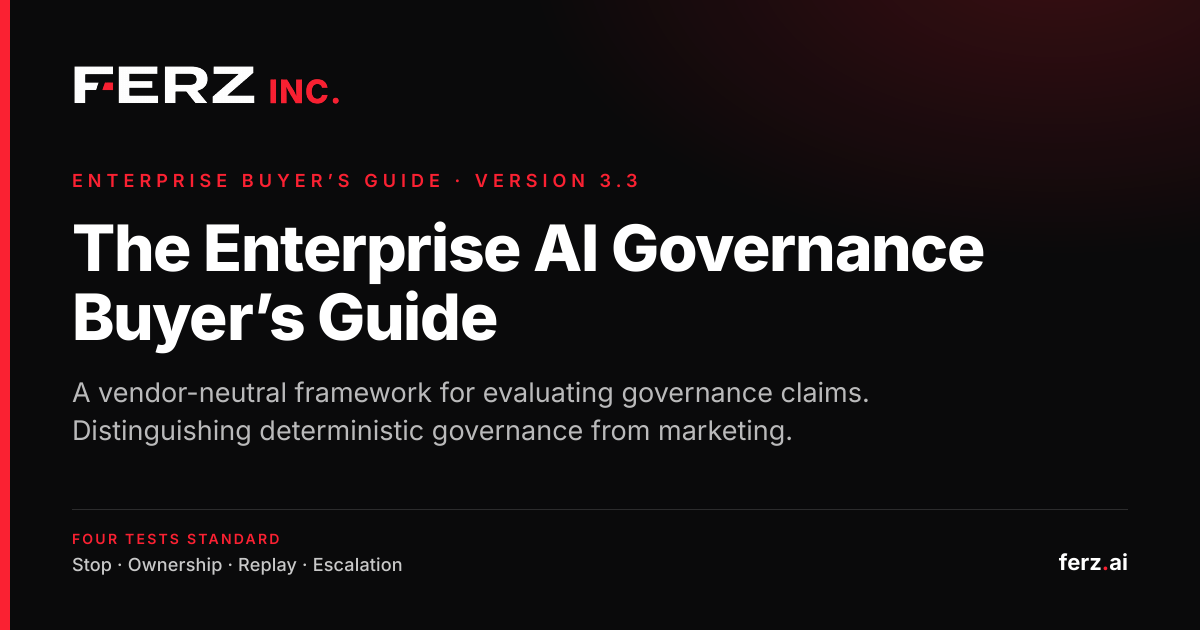
Enterprise AI Governance Buyer's Guide
A Framework for Evaluating Vendor Claims: Distinguishing Deterministic Governance from Marketing
FERZ | June 2026 | Version 3.4
Download the complete guide:
The Problem: Marketing vs. Technical Substance
The AI governance market is saturated with solutions marketed as "guardrails," "responsible AI," "ethical AI," and "trustworthy AI." These terms lack precise technical definitions, making it difficult for procurement teams, risk officers, and technical evaluators to distinguish substantive capabilities from marketing claims.
This guide provides a vendor-neutral framework for evaluating AI governance solutions, distinguishing three categories of claims:
- Marketing claims ("our AI is safe and responsible")
- Statistical governance (probabilistic approaches providing confidence intervals)
- Deterministic governance (fail-closed enforcement with reproducible, auditable decision artifacts)
Core Principle: Logs Are Not Proof
Most AI systems produce logs. Logs record what happened. Proof demonstrates that governance can be independently verified at decision time.
The difference: after an adverse event, can you independently verify—not just review logs—that the system was operating within its intended parameters? If no, you have statistical confidence at best.
Who Should Use This Guide
Procurement teams evaluating AI vendors. Chief Risk Officers assessing deployment risks. General Counsel evaluating liability. Technical evaluators conducting due diligence. Federal acquisition officers reviewing proposals. Board members seeking governance assurance.
Probabilistic vs. Deterministic Governance
The core technical distinction evaluators must understand is between probabilistic governance (statistical confidence that a system usually behaves correctly) and deterministic governance (deterministic certainty that every action was validated before execution).
Probabilistic: "Likely Compliant"
Probabilistic approaches—including RLHF, Constitutional AI, content filtering, and most guardrails—operate on statistical principles. They provide confidence that a system will usually behave correctly, but cannot guarantee behavior for any specific decision.
Key limitation: at enterprise scale, even small residual failure rates produce frequent governance escapes. A 99% success rate means 10,000 failures per million decisions.
Deterministic: "Provably Compliant"
Deterministic governance provides fail-closed enforcement with reproducible, independently verifiable audit artifacts. Every AI output passes through a validation layer that checks explicit rules. If validation fails, the output is blocked. Every decision generates a verifiable proof bundle.
Key advantage: after an adverse event, governance compliance can be independently verified by third parties. Liability can be allocated based on provable governance state at decision time.
The Four Tests Standard
The Four Tests Standard (4TS) provides a vendor-neutral framework for evaluating AI governance claims. Its four canonical tests are Stop, Ownership, Replay, and Escalation. Governance claims can be assessed against them.
-
Stop. Can execution be halted before a side effect occurs? Pass: the system can be halted before side effects, effect-token issuance is gated by approval, and no execution pathway bypasses the boundary.
-
Ownership. Who authorized the governing policy, and when? Pass: an identified authority signs the policy prior to the execution window. Authorization is non-delegable and attributable.
-
Replay. Can the decision be reproduced at the boundary? Pass: the decision is reproduced by state or by protocol, and a third party reconstructs the verdict offline from the Evidence Package, without trusting vendor attestations and without access to the governed system.
-
Escalation. What happens on denial or at a threshold crossing? Pass: mandatory custody transfer routes on denial or threshold crossings, and ABSTAIN triggers explicit escalation, treated as DENY by default pending authorized override.
Buyers familiar with reproducibility and verifiability as evaluation dimensions will find both inside Replay. Coverage and no-bypass are carried by the State Completeness check and the non-bypassable boundary. Residual-risk bounds, where ungoverned inputs are forced to DENY or ABSTAIN, are carried by fail-closed handling, ABSTAIN semantics, and diligence scoring.
A governance system that cannot pass all four tests provides statistical confidence at best. It cannot provide the proof-level assurance required for regulated or high-stakes environments.
| Dimension | Probabilistic | Deterministic | |||| | Assurance Level | Statistical confidence | Deterministic certainty of verdict | | Failure Mode | Silent failures possible | Fail-closed (blocked if uncertain) | | Audit Capability | Logs exist; reproducibility unlikely | Canonical verification outputs with tamper-evident proof artifacts | | Post-Incident Proof | Cannot prove governance state | Third-party verifiable | | Residual Risk | Unknown tail risk | Bounded by rule coverage | | Liability Posture | Difficult to allocate | Clear boundary definitions |
Red Flags: Marketing Language to Question
"Enterprise-grade safety." No technical definition. Pure marketing. Ask: what specific technical mechanisms enforce safety, and at what layer?
"95% accuracy." A 5 percent failure rate is 50,000 failures per million decisions. Ask: what happens to the 5 percent, and can you prove which decisions were in it?
"Comprehensive guardrails." Guardrails can be bypassed. There is no guarantee of enforcement. Ask: what is the default behavior when guardrails cannot validate, fail-open or fail-closed?
"Auditable AI." Logs are not audit proof. Most logs cannot be independently verified. Ask: can a third party replay any historical decision and obtain identical results?
"Formally verified governance." Type systems and formal methods are verification substrates, not governance mechanisms. Ask: does the verification operate within a governance envelope that provides policy authority, escalation, and audit integration?
Technical Due Diligence Questions
Architecture Questions
- At what layer does your governance operate? (Model, Application, or Deployment)
- Is governance validation performed before or after execution?
- What is the default behavior when governance cannot validate an action?
- Can your system operate with any AI model, or is it tied to a specific provider?
Compliance Verification Questions
- How do you prove that governance can be independently verified for a specific historical decision?
- Can a third party independently verify your compliance claims without trusting your attestations?
- What cryptographic mechanisms ensure audit trail integrity?
- How do you satisfy regulatory requirements for electronic records and signatures?
Failure Mode Questions
- What happens on governance system outage? (Acceptable: all AI actions blocked until restored)
- What happens when policy is missing for an action type? (Acceptable: action denied or escalated)
- What happens when cryptographic verification fails? (Acceptable: action blocked, alert generated)
Industry-Specific Considerations
The complete guide includes detailed regulatory mappings for each sector:
- Healthcare: FDA 21 CFR Part 11, HIPAA, CLIA, ONC Health IT Certification
- Financial Services: SOX, SEC Rule 17a-4, FINRA, Basel III and IV, EU DORA
- Government: FedRAMP, FISMA, NIST AI RMF, DoD AI Principles
- EU AI Act: risk management, technical documentation, record-keeping, human oversight
Key Takeaways
- Logs are not proof.
- Accuracy percentages hide tail risk.
- "Enterprise-grade" is marketing, not architecture.
- If they cannot replay the decision, they cannot prove the governance.
- Deterministic governance creates clear liability boundaries. Probabilistic governance increases dispute risk.
- If the governed state does not include semantic snapshot binding, definitions can change underneath you.
- Observability cannot produce a pre-execution authorization artifact. That absence is the artifact gap: oversight evidence may exist, but no authorization artifact preceding execution can be produced.
Download the Complete Guide
The full 22-page guide includes the Governance Capability Matrix, Proof-Carrying Decision artifact examples, Five Anti-Laundering Tests, canonical definitions, regulatory requirement mappings, and deployment architecture checklists.
Version 3.4 | June 2026
© 2026 FERZ, Inc. All rights reserved.